Why Fort Bend Roofs Take a Beating
Sugar Land sits squarely in the Gulf storm corridor, and the weather here attacks roofs in three distinct ways — each leaving different damage behind.
Hurricanes and tropical storms
Sustained wind and wind-driven rain are the main threat. Wind lifts shingles at ridges, eaves, and edges, then rain gets driven sideways under the lifted courses. Flashing that held through normal rain can fail when water is pushed uphill against it. After a tropical system, we commonly find creased shingles (bent but not missing), lifted ridge caps, and water intrusion at valleys and wall transitions.
Spring hail
March through June brings the hail season. Unlike wind, hail damage is often invisible from the ground — bruised shingles, knocked-off granules, and cracked mats that only show on close inspection. Our hail damage page goes deep on how hail actually breaks down a shingle and why timing matters.
Heat and UV between storms
Months of strong Texas sun make asphalt shingles brittle and dry out sealants and pipe boots. A roof that survived last year's storm season on flexibility alone can fail this year because the materials have aged. This is why storm damage often looks worse on older roofs — the storm was the trigger, not the whole story.
Wind Damage vs. Hail Damage: Different Signs
Homeowners often lump all storm damage together, but wind and hail leave different evidence — and they call for different repairs.
- Wind damage shows as missing, lifted, or creased shingles, often in streaks along ridges and edges where uplift forces are strongest. You may find shingles in the yard. The fix is usually targeted: replace the affected courses, reseal, and check adjacent shingles that were loosened but not torn away.
- Hail damage shows as dark impact spots, bruising you can feel more than see, granules collecting in gutters and downspouts, and dented vents, flashing, or gutters. Hail rarely removes shingles outright — it wounds them, and the wound shortens the roof's life.
- Both at once is common in severe cells. A thorough inspection documents each type separately, because repairs — and insurance scopes — treat them differently.
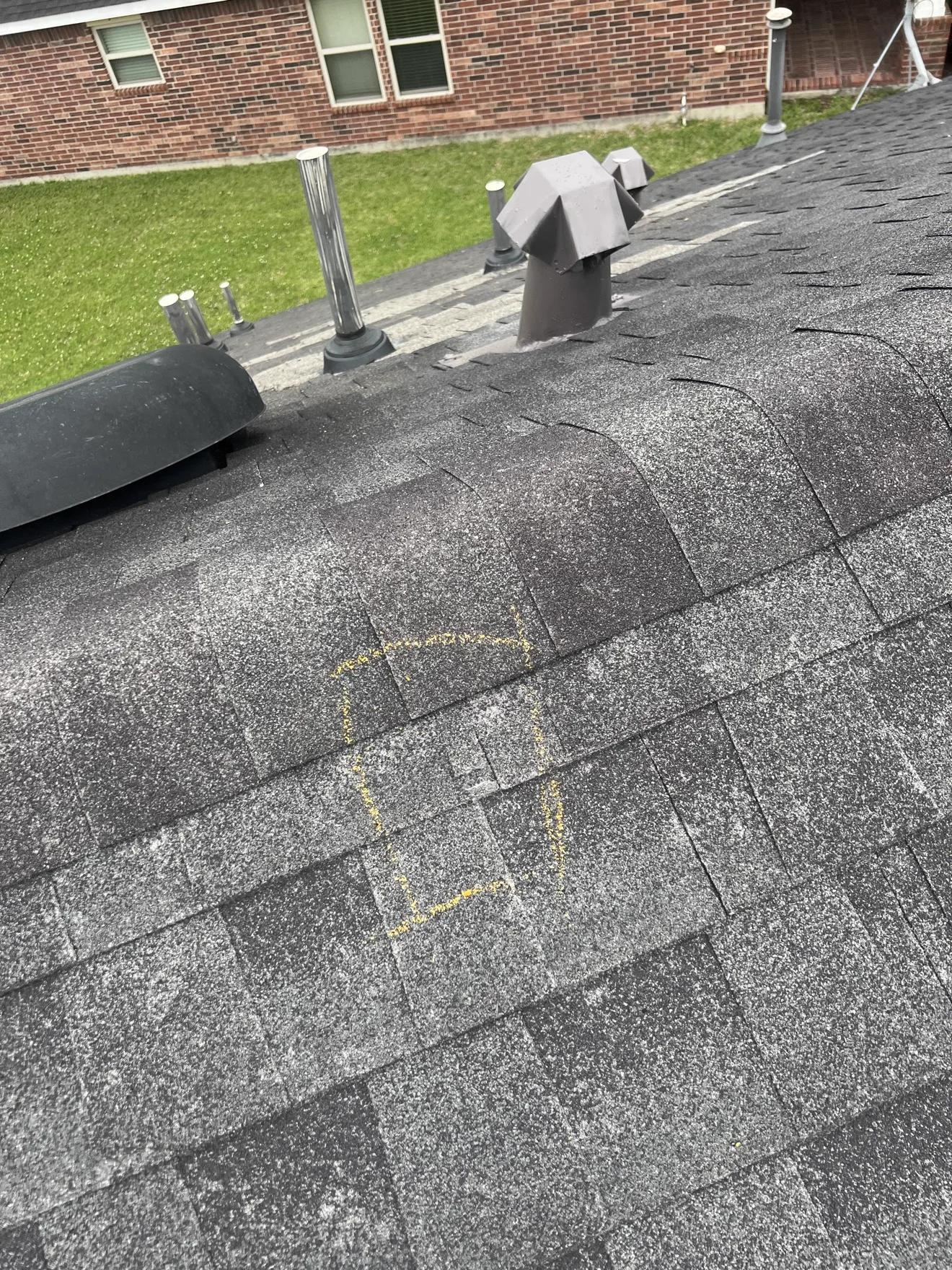
Chalk-marked hail damage — visible only on close inspection.
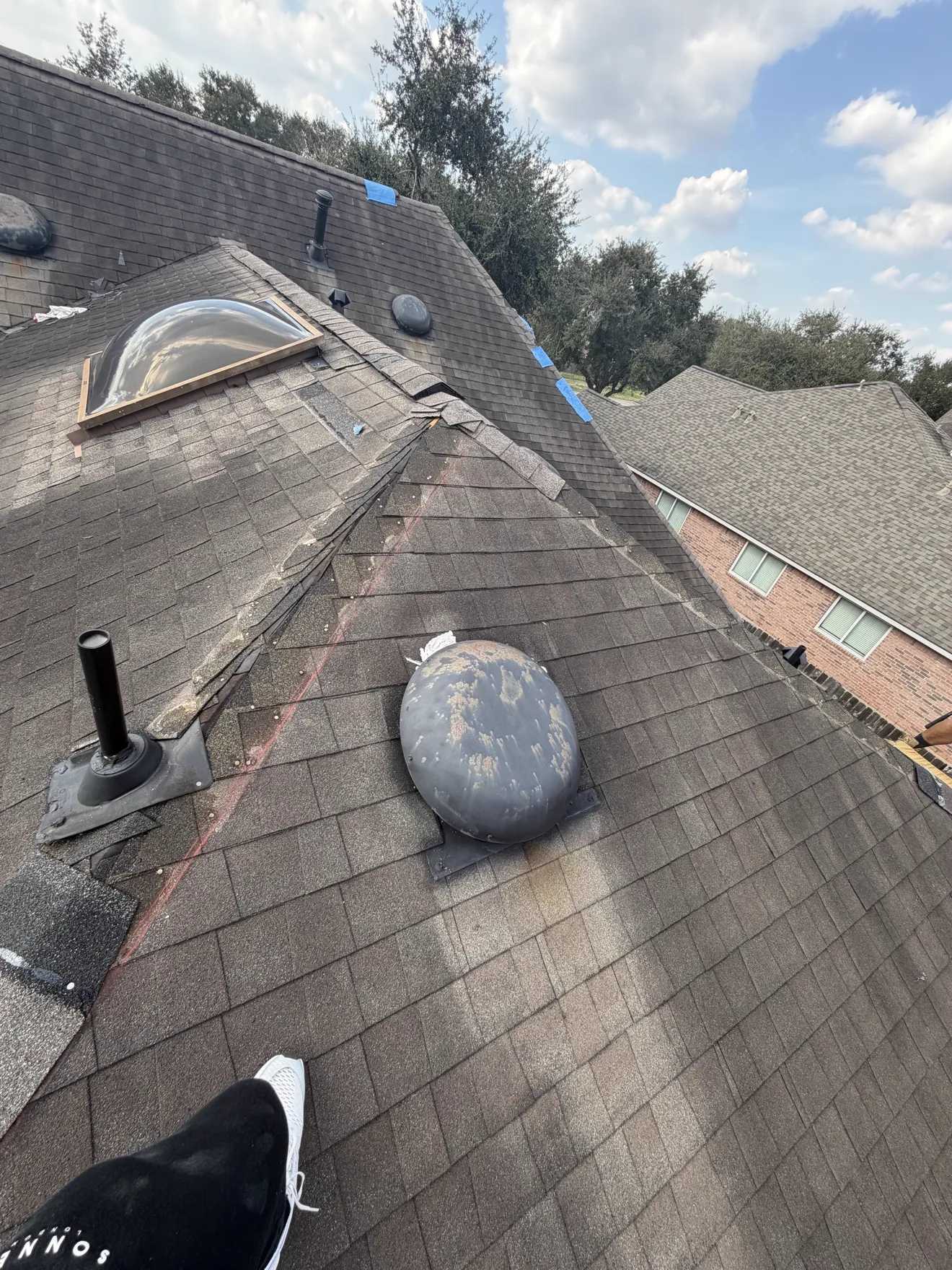
Storm damage marked with blue tape during an inspection.
What to Do in the First 48 Hours After a Storm
The actions you take right after a storm shape everything that follows — the repair, the documentation, and the insurance outcome.
- Stay off the roof. Wet shingles are slick, and storm-weakened decking can give way. Document from the ground and the attic instead.
- Photograph what you can see safely. Shingles or debris in the yard, dented gutters, water stains inside — timestamped photos from the homeowner carry weight later.
- Stop active water first. If water is entering the home, call us any time. Emergency tarping halts the damage while the permanent plan is made. Buckets and moved valuables protect the interior in the meantime.
- Get a professional inspection while damage is fresh. Hail marks weather and fade; wind-lifted shingles reseal in heat and become harder to prove. Our free drone inspection documents every slope with photos and a written report.
- Check your policy deadlines. Many homeowners policies require prompt notice of storm damage. You do not need the full picture before calling your insurer — but you do need to call.
- Be cautious with door-knockers. After every major storm, out-of-town crews canvas damaged neighborhoods. Work with a roofer you can find after the check clears — one based where you live.
Free Drone Inspections and Documentation
Our storm inspection is free whether or not you file a claim, and it produces something concrete: high-resolution photos of every slope, ridge, valley, flashing detail, and vent — including areas unsafe to walk — plus a written report of what we found.
We also check the attic for water paths and damp insulation, because the roof surface only tells half the story. You keep the photos and the report. If the roof came through fine, we tell you that too — not every storm damages every roof, and we do not manufacture damage to sell work.
Emergency Tarping: Triage, Not Treatment
When water is actively entering your home, the first job is to stop it. We tarp the affected area as soon as conditions are safe — no one goes on a roof in lightning or dangerous wind, and we will tell you straight if we need to wait out the weather.
The tarp is triage. Once the immediate threat is controlled, we come back for the full inspection, the documentation, and the permanent repair or replacement. Emergency work is available 24/7, nights, weekends, and holidays.
Insurance-Claim Help, Step by Step
We are not adjusters, and we cannot promise what your insurer will approve — anyone who guarantees approval is selling you something. What we do is make the process straightforward and honest:
- We document. Photos, measurements, and a written damage report from the free inspection.
- You file. Contact your insurer and open the claim. Having our report in hand means you describe actual findings, not guesses.
- We meet the adjuster. We can be on site with the damage report and photos when the adjuster inspects, so nothing visible gets missed.
- We do the work. Approved repairs or replacement are completed to the agreed scope, backed by our written labor warranty — 2 years on repairs, 5 years on new installs, both transferable if you sell.
If a claim is denied or under-scoped, we can review the adjuster's report with you and explain your options, including re-inspection requests. The decision always stays with you and your insurer.
Repair or Replace After Storm Damage?
It depends on the roof's age and how widespread the damage is. Isolated wind damage on a mid-life roof usually means targeted roof repair — replace the torn courses, reseal, verify the rest. Widespread hail bruising across multiple slopes, or a roof already near the end of its service life, often points toward replacement.
When it is a close call, we lay out both options with honest pricing and let you decide. Our job is to show you the roof's real condition — with photos — not to steer you toward the bigger invoice.